
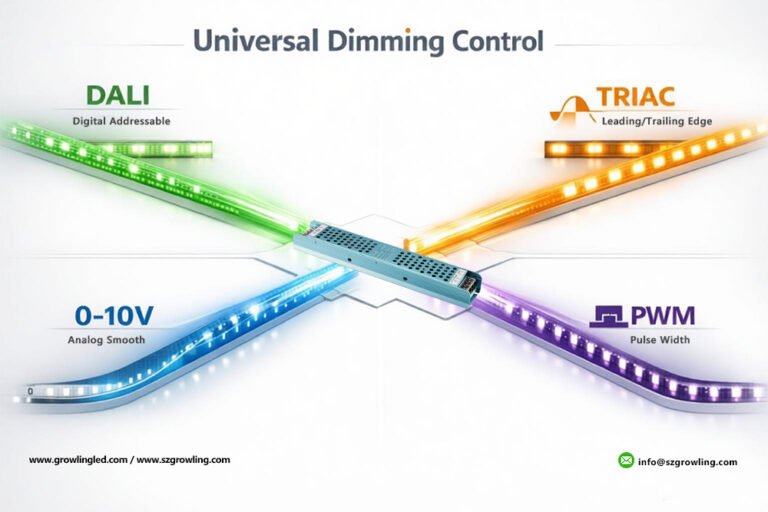
Introduction: Navigating the World of LED Dimming
Dimming is no longer a luxury—it’s a fundamental requirement for modern LED lighting systems, enabling energy savings, ambiance creation, and smart building integration. However, with multiple protocols like DALI-2, 0-10V, TRIAC, and PWM on the market, selecting the right dimming method for your LED driver can be a complex technical decision.
A mismatch between the driver, dimmer, and control system leads to the most common issues: flickering lights, limited dimming range, audible buzzing, and incompatibility headaches. This guide cuts through the confusion.
DALI/DALI-2: The Standard for Intelligent Digital Control
DALI (Digital Addressable Lighting Interface), and its enhanced successor DALI-2, is a dedicated, two-way digital communication protocol specifically designed for professional lighting control.
How It Works & Key Advantages
Unlike analog methods, DALI sends digital commands between a controller and drivers/devices over a simple two-wire bus (polarity-insensitive). Each driver has a unique address, allowing for individual or group control, scene setting, and status feedback (e.g., lamp failure, energy consumption).
- DALI-2 Certification ensures true interoperability between devices from different manufacturers, a significant upgrade from legacy DALI.
- Key Advantage: It offers unparalleled system flexibility and intelligence. You can reconfigure lighting groups and scenes via software without rewiring.
Ideal Application Scenarios
Large Commercial Buildings: Offices, hospitals, and schools where zoning, daylight harvesting, and energy management are critical.
Advanced Architectural Lighting: Projects requiring dynamic scene control for museums, hotels, or high-end retail.
0-10V Dimming: The Simple, Reliable Analog Standard
0-10V dimming is one of the oldest and most widely understood analog control protocols. Its simplicity is its greatest strength.
How It Works & Key Advantages
The controller provides a separate, low-voltage DC signal between 0 and 10 volts to the driver. Typically:
- 10V = Maximum light output (100%).
- 0V = Minimum light output (usually 0-10%, depending on driver).
There are two variants: Current Sink (Type I) and Current Source (Type II). For LED drivers, the current sink is most common.
Key Advantage: It is incredibly simple, reliable, and cost-effective for basic dimming without the need for individual addressing or programming.
Ideal Application Scenarios
Commercial & Industrial Spaces: Warehouses, factories, and classrooms where simple, area-wide dimming is sufficient.
Retrofit Projects: Easily integrating with existing 0-10V control systems from fluorescent or earlier LED installations.
TRIAC (Leading-Edge)/ELV (Trailing-Edge) Dimming: The Legacy Wall-Dimmer Solution
TRIAC dimming refers to phase-cut dimming designed to work with standard AC wall dimmers, prevalent in residential and some commercial settings.
How It Works & Key Challenges
The wall dimmer “chops” parts of the AC sine wave to reduce power. TRIAC (Leading-Edge) cuts the front of the wave, while ELV (Electronic Low Voltage, or Trailing-Edge) cuts the back. The LED driver must have internal circuitry to interpret this chopped signal and dim accordingly.
The Core Challenge: Mismatch. These dimmers were made for resistive incandescent bulbs, not complex LED drivers. This causes flicker, limited range, buzzing, and requires meticulous compatibility testing.
Key Consideration: Performance is highly dependent on the specific dimmer-driver-LED combination. A compatibility list is essential.
Ideal Application Scenarios
Residential Retrofits: Where existing wall dimmers must be reused.
Hospitality & Small-Scale Commercial: Projects requiring a familiar wall-dimmer user interface.
PWM Dimming: The Technical Solution for Flicker-Free Performance
PWM (Pulse Width Modulation) is not a control protocol per se, but a dimming technique internal to many LED drivers, often used to achieve the actual light output dictated by a control signal (like 0-10V or DALI).
How It Works & Key Advantages
- PWM works by switching the LED current on and off at a very high frequency (often hundreds of Hz to kHz). The duty cycle (percentage of “on” time) determines perceived brightness.
- 100% duty cycle = full on.
- 25% duty cycle = 25% brightness.
Key Advantage: When implemented with a high enough frequency, it provides true, flicker-free dimming down to 0.1% or lower without shifting the LED’s color temperature (chromaticity), which is a common issue with analog current reduction (CCR).
Ideal Application Scenarios
High-End Architectural & Museum Lighting: Where absolute dimming smoothness and color consistency are paramount.
Medical & Studio Lighting: Applications that are extremely sensitive to any visual flicker.
Protocol Comparison & Selection Guide
Use this table to quickly compare the core characteristics of each method:
| Feature | DALI-2 | 0-10V | TRIAC/ELV | PWM |
| Type | Digital, Addressable | Analog, Voltage-Based | AC Phase-Cut | Digital Switching Technique |
| Control Wires | 2 (Polarity-Free, Bus) | 2 (Separate Low-Voltage) | 2 (Integrated with AC Power) | Internal to Driver |
| Communication | Two-Way (Feedback) | One-Way | One-Way | N/A (Internal) |
| System Flexibility | Very High (Software Configurable) | Low (Hardwired Zones) | Very Low (Per Circuit) | Dependent on Input Signal |
| Installation Cost | Higher (System, Commissioning) | Low | Low (But Requires Compatibility) | Integrated |
| Best For | Smart Buildings, Complex Scenes | Simple Commercial/Industrial | Residential Retrofits | Flicker-Sensitive, High-Performance |
How to Choose: A Step-by-Step Decision Framework
Follow this logic to narrow down your optimal choice:
- Identify the Control Source & User Need:
- Is this a new build or a retrofit? (Retrofits may be locked into TRIAC or 0-10V).
- Will control be from a smart building system, a simple wall slider, or an automated sensor?
- Does the project require individual light control, grouping, or energy reporting? (If yes, choose DALI-2).
2. Assess Performance Requirements:
- What is the required dimming depth? (e.g., 1% vs 10% minimum).
- Is absolute flicker-free performance or color consistency critical? (Prioritize drivers using high-quality PWM).
- How many zones or individual controls are needed?
3.Evaluate Cost & Complexity Constraints:
- Budget: Includes control gear, wiring, and commissioning labor. DALI has higher upfront cost but offers long-term value.
- Willingness to Test: For TRIAC, factor in the time/cost of procuring samples and testing for compatibility.
Decision Flow Summary:
Choose DALI-2 for intelligent, flexible, and future-proof commercial systems.
Choose 0-10V for simple, reliable, and cost-effective area dimming.
Choose TRIAC-Compatible Drivers only when mandated by existing wall dimmers, and always verify with a compatibility list.
Ensure your chosen driver uses high-frequency PWM technology for the actual dimming output to guarantee smooth, flicker-free light.
Conclusion & Next Steps
There is no single “best” dimming protocol—only the best one for your specific project’s requirements, constraints, and goals. DALI-2 stands out for professional digital control, 0-10V for straightforward analog reliability, and TRIAC compatibility remains a necessary bridge to the past. Underlying all, PWM quality is the unsung hero determining final visual performance.
➔ Explore Our Dimmable LED Power Supplies
➔ Contact Our Sales Team