
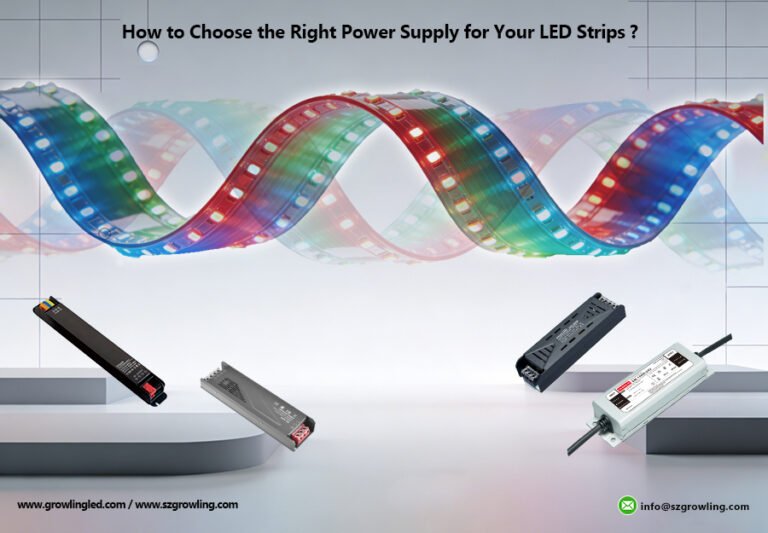
When you finished chosen the perfect LED strips for your project—but the job is only half done. The single most critical component that determines whether your installation shines brilliantly or fails prematurely is the LED Strip Power Supply (LED Driver).
Choosing the wrong one can lead to dim lights, flickering, or even a safety hazard. This guide will walk you through the 5 essential steps to select the perfect power supply for your LED strips, ensuring a professional, reliable, and long-lasting result.
Step 1: Calculate the Total Power (Wattage) – The Golden Rule
This is the most crucial step. Under-sizing your power supply is the #1 cause of failure.
1.Find Wattage per Meter/Foot: Check your LED strip’s specifications. It’s usually listed as W/m or W/ft. (e.g., 14.4 W/m for a high-density strip).
2.Measure Total Length: Calculate the total length you plan to power continuously.
3.Do the Math: Total Wattage = Wattage per Unit × Total Length
Example: A 5-meter strip at 14.4 W/m requires 14.4 × 5 = 72 Watts.
4.The 20% Safety Margin: Always add at least 20% extra capacity to avoid running the power supply at its absolute limit, which prolongs its life. For our 72W requirement: 72 × 1.2 = 86.4W. So, you should look for a power supply rated for at least 90W.
Step 2: Determine the Correct Voltage: 12V vs. 24V
Your power supply voltage MUST match your LED strip voltage.
12V Strips: Most common for DIY and shorter runs (up to 5-10 meters). More affordable, but can suffer from voltage drop (dimming) over longer distances.
24V Strips: Increasingly popular. They experience less voltage drop over the same distance, allowing for longer single runs (up to 15-20 meters) without dimming at the end. They are generally more energy-efficient.
Pro Tip: Check the label on your LED strip reel or product page. Never connect a 12V strip to a 24V supply (it will burn out), or vice versa (it will be very dim).
Step 3: Choose the Right Type & Protection (IP Rating)
Where will your LED strips be installed? The location dictates the power supply type.
Type of Power Supply Key Features Best For Enclosed (Sealed) Plastic or metal case, basic protection from dust and accidental touch. IP rating like IP67. Indoor use in dry locations (cabinet interiors, coves, bedrooms). Waterproof (IP67/IP68) Sealed in a rugged case, often with potting compound inside. Can withstand rain, moisture, and low-pressure water jets. Outdoor use, bathrooms, kitchens, or any damp location. Open Frame (Ventilated) Exposed circuit board for maximum heat dissipation. Highest efficiency and power capacity. Enclosed indoor fixtures with good ventilation (sign boxes, custom furniture, professional installations).
Step 4: Consider Connection & Smart Features
Connection: Most power supplies use terminal blocks for secure wiring. For plug-and-play setups, look for ones with standard DC barrel connectors or screw-on adapters.
Dimming Capability: Do you want to dim your lights?
For PWM Dimmers: Ensure your LED strips are dimmable and get a constant voltage power supply.
For Smart Homes: Choose a power supply compatible with your system (e.g., DALI, 0-10V, or smart Wi-Fi controllers that connect between the power supply and the strip).
Step 5: Prioritize Safety & Reliability – Look for Certifications
Never compromise on safety. A quality power supply is a long-term investment.
Essential Certifications: Always look for CE, RoHS, and for your region, FCC or UKCA. These marks indicate compliance with safety and electromagnetic interference standards.
Protections: Good units include Short-Circuit Protection (SCP), Overload Protection (OLP), and Over-Temperature Protection (OTP).
Final Checklist Before You Buy
Before making your purchase, quickly run through this list:
Wattage: Power supply rating > (Total Strip Wattage + 20%).
Voltage: 12V or 24V – must match your LED strip.
IP Rating: Suitable for your installation environment (IP20 for dry indoor, IP67 for damp/outdoor).
Certifications: Has CE/RoHS marks for safety.
Connectors: Has the right output connectors for your project.
Dimming: Compatible with your chosen dimming method (if needed).
Conclusion
Choosing the right power supply isn’t just about making your LED strips light up—it’s about ensuring they perform brightly, reliably, and safely for years to come. By following these five steps, you move from guesswork to a confident, professional-grade selection.
Ready to Power Your Vision?
Browse our extensive range of high-efficiency, certified Constant Voltage LED Power Supplies—from compact indoor units to robust waterproof drivers—perfect for any strip lighting project.