
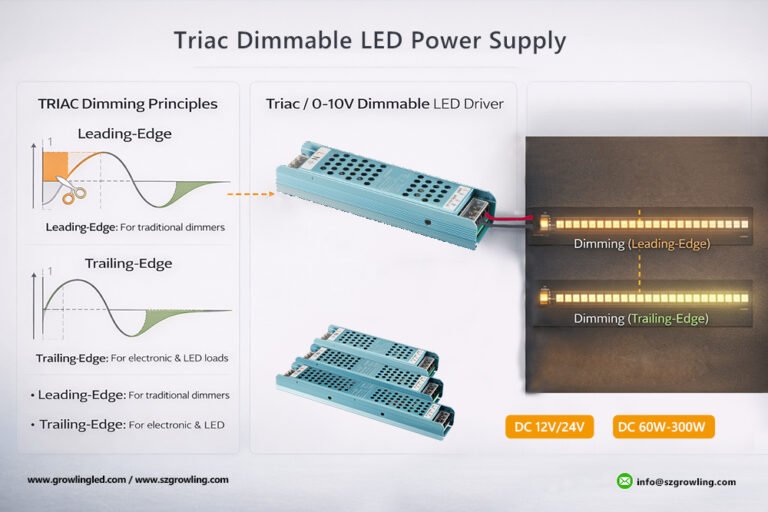
Why TRIAC Dimming Still Matters
If you’re upgrading from traditional lighting to LEDs or working on residential and commercial retrofit projects, you’ve likely encountered TRIAC dimming. As one of the most common dimming standards inherited from the incandescent era, getting it right is crucial for flicker-free performance, full dimming range, and quiet operation.
Understanding the Core Challenge
A TRIAC (Triode for Alternating Current) dimmer works by “chopping” parts of the AC sine wave to reduce power. It was designed for simple resistive loads like incandescent bulbs. LED drivers, however, are complex electronic loads. This mismatch causes common issues:
Flickering or strobing
Limited dimming range (e.g., won’t dim below 20%)
Audible buzzing from the driver or dimmer
Inconsistent performance or drop-outs
To solve this, LED driver engineers have developed several technical approaches.
Method 1: Leading-Edge (Forward-Phase) Dimming Compatibility
This is the most common and traditional form of TRIAC dimming.
How It Works: The dimmer cuts off the front part of each AC half-wave. The compatible LED driver must include a specialized “bleeder circuit” or dimmer detection circuit. This circuit provides the minimum holding current the TRIAC needs to stay triggered, preventing it from turning off prematurely and causing flicker.
Driver Design Focus: Ensuring stable current at low dimming levels and managing inrush currents.
Best For: Cost-sensitive residential retrofits where standard, existing wall dimmers are used. Compatibility lists are crucial.
Limitations: Can be less efficient due to the bleeder circuit. Performance heavily depends on the specific dimmer model and minimum load requirements.
Method 2: Trailing-Edge (Reverse-Phase) Dimming Compatibility
Often seen as a more advanced, LED-friendly alternative.
How It Works: The dimmer cuts off the back part of the AC wave. This typically uses electronic switches (like MOSFETs) instead of a TRIAC. The compatible LED driver is designed to handle this cleaner cut-off signal.
Driver Design Focus: Filtering and signal interpretation for smooth low-end dimming.
Best For: New installations where you can specify high-quality dimmers. Excellent for achieving a very smooth dimming curve down to low light levels (often 1-10%). Ideal for LED bulbs and higher-end residential/commercial applications.
Limitations: Dimmers are often more expensive. Not a direct replacement for existing leading-edge dimmer switches without changing the dimmer itself.
Method 3: Smart & Digital TRIAC-Compatible Drivers
This is where modern innovation solves legacy problems.
How It Works: The driver incorporates a microcontroller or intelligent sensing circuit. It actively analyzes the chopped AC waveform from any connected TRIAC dimmer, then dynamically adjusts its internal circuitry to maintain stability.
Key Technology: Auto-Detection & Adaptive Compensation. These drivers can often work with both leading and trailing-edge dimmers without manual switches.
Best For: Applications requiring universal compatibility, such as lighting manufacturers who want one driver SKU to work with a vast array of dimmers. Provides the most plug-and-play user experience.
Limitations: Higher driver cost due to added intelligence, but reduces support headaches and returns.
Method Comparison & Selection Guide
| Method | Key Technology | Pros | Cons | Ideal Use Case |
|---|---|---|---|---|
| Leading-Edge Compatible | Bleeder / Holding Current Circuit | Low-cost drivers, works with common dimmers | Potential flicker at low end, efficiency loss | Retrofit projects, budget-conscious builds |
| Trailing-Edge Compatible | MOSFET-based Filtering | Smooth dimming, quiet, better low-end performance | Requires specific (often pricier) dimmers | New builds, premium residential, hospitality |
| Smart Digital | Microcontroller & Adaptive Algorithms | Broadest compatibility, stable performance | Higher driver unit cost | OEMs needing one solution for all markets |
How to Ensure Successful TRIAC Dimming
Match the Driver to the Dimmer: Always consult the driver’s compatibility list. The best results come from tested pairings.
Consider the Minimum/Maximum Load: Old dimmers often have a high minimum load (e.g., 25W). Ensure your total connected LED wattage exceeds this, or use a dimmer compatible with low-wattage LEDs.
Prioritize Quality: Invest in drivers from reputable manufacturers who design specifically for robust dimming performance. Look for certifications.
Test Before Full Installation: Always prototype the dimmer-driver-LED combination to verify performance across the entire range.
Conclusion & Recommendation
Choosing the right TRIAC dimming method balances cost, compatibility, and performance.
For simple retrofits, a quality Leading-Edge compatible driver from a proven compatibility list is sufficient.
For new installations where performance is key, specify Trailing-Edge dimmers and drivers.
For product manufacturers seeking reliability across diverse markets, Smart Digital drivers minimize risk.The future of dimming is moving towards DALI and wireless protocols, but TRIAC will remain a critical requirement for years to come. Selecting the right driver method ensures customer satisfaction and flawless operation.
➔ Explore Triac Dimmbale LED Power Supplies
➔ Contact Our Sales Team