
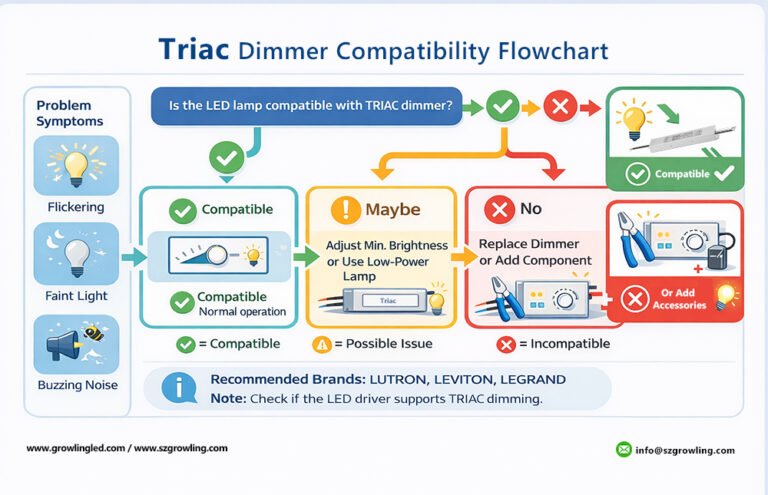
The #1 Problem in Lighting Retrofits: “My New LEDs Flicker with My Old Dimmer”
You’ve decided to upgrade to energy-efficient LED lighting but want to keep the existing wall dimmers. It sounds simple—swap the bulbs or drivers and enjoy dimmable LEDs. Instead, you’re greeted with a frustrating light show: flickering at low levels, an audible buzz from the fixture, dead travel zones on the dimmer, or lights that simply won’t turn off completely.
This mismatch is the most common headache in residential and commercial retrofit projects. The culprit is rarely a “defective” product. It’s a fundamental incompatibility between legacy TRIAC/Leading-Edge dimmer technology and modern LED drivers.
This guide cuts through the technical jargon to provide a clear, step-by-step methodology for successfully matching an existing TRIAC dimmer to a flicker-free LED driver, ensuring professional results every time.
Why the Mismatch Happens: A Quick Technical Primer
A traditional TRIAC dimmer was designed to control a simple resistive load—an incandescent bulb. It works by “chopping” the AC voltage waveform. To stay active, it requires a certain amount of current to continuously flow (the holding current).
An LED driver, however, is a complex electronic device with capacitors and filters. It draws current in small, efficient bursts and often falls below the dimmer’s minimum holding current requirement, especially at low brightness. This causes the TRIAC to turn on and off erratically, resulting in visible flicker.
A truly compatible driver must incorporate intelligent circuitry to present a stable, sufficient load to the dimmer across its entire range.
Step-by-Step Guide to Guarantee Compatibility
Step 1: Audit Your Existing Dimmer
Before choosing a driver, gather critical information:
Dimmer Model & Brand: Find the exact model number. Older, high-wattage dimmers (e.g., rated for 600W incandescent) are often the most problematic for low-wattage LED loads.
Minimum Load Rating: Check the dimmer’s datasheet for its minimum load rating (e.g., “Min 25W”). The total wattage of your connected LEDs must exceed this number. This is a critical, often overlooked factor.
Dimmer Type: Confirm it’s a standard leading-edge (TRIAC) dimmer. If it’s a newer trailing-edge (ELV) dimmer, your driver selection options improve.
Step 2: Calculate the Total Connected Load
Sum the maximum wattage of all LED fixtures or strips that will be connected to the single dimmer circuit.
Apply the 20-30% Headroom Rule: Ensure your driver’s maximum output capacity is 20-30% higher than this total load. This prevents the driver from operating at 100% capacity, which stresses components and worsens dimming performance.
Compare to Dimmer Minimum: Your total load must be greater than the dimmer’s minimum load rating.
Step 3: Select the Right Driver with These 4 Non-Negotiable Specs
When reviewing driver specifications, look for these explicit features:
“TRIAC Dimmable” or “Leading-Edge Dimmable” Designation: This is the baseline.
Compatibility Lists: The most reliable indicator. Reputable manufacturers provide tested compatibility lists naming specific dimmer models that perform well with their drivers. Prioritize drivers with a published list that includes your dimmer model.
Wide Dimming Range with Low-End Stability: Look for specs like “1%-100% dimming” and phrases like “stable at low end” or “smooth, flicker-free dimming.” This indicates advanced internal circuitry.
Inrush Current Protection: High inrush current when turning on can damage or confuse older dimmers. Drivers with soft-start technology mitigate this.
Step 4: The Real-World Test (Before Full Installation)
Never skip this validation step.
Create a Test Rig: Wire one new driver and one LED fixture to the existing dimmer in a temporary setup.
Test the Full Range: Slowly cycle the dimmer from off to full on and back. Observe for:
Smooth, flicker-free operation across the entire slider range.
No audible buzzing from the dimmer or driver.
The light turns off completely at the lowest setting.
No random popping on/off.
Test with Multiple Drivers: If dimming multiple fixtures, test with the exact number of drivers/fixtures that will be on the final circuit.
Pro Recommendation: When to Consider a Dimmer Upgrade
Sometimes, achieving perfect performance with a very old dimmer is not cost-effective. Consider replacing the dimmer if:
It’s a very old, high-wattage (e.g., 1000W) incandescent dimmer.
The total LED load is very low (under 20W).
You desire optimal, smooth performance.
In this case, pair a new, LED-specific dimmer (compatible with low-wattage loads) with your chosen LED driver. Many modern “smart dimmers” also offer superior performance.
Conclusion: Your Checklist for Success
Matching an existing TRIAC dimmer doesn’t have to be guesswork. Follow this proven process:
Identify your dimmer model and its minimum load.
Calculate your total LED wattage with a 20-30% headroom.
Select a driver from a published compatibility list that includes your dimmer.
Always prototype and test a single unit before full installation.
Investing time in this selection process saves costly callbacks, replacements, and ensures a satisfied client with professional, flicker-free dimming.
➔ Explore Our Triac Dimmable LED Power Supplies
➔ Contact Our Sales Team