
The Reality Hitting Your Projects
If you’ve sourced LED drivers recently, you’ve noticed the trend: prices are climbing across the board.
Since early 2026, over 50 lighting manufacturers have issued price adjustment notices. Industry leader Inventronics announced 5-15% increases
effective March 1, citing “core raw material prices general increase.” Sosen followed with 5-15% hikes across its entire LED power supply line
starting March 16.
For procurement professionals, this creates a genuine dilemma:
- How do you maintain margins when a key component jumps 5-15%?
- How do you ensure supply stability when multiple suppliers adjust simultaneously?
- How do you balance quality and compliance against relentless budget pressure?
The answer isn’t “find the cheapest option”—that path leads to field failures and costly callbacks. Instead, smart buyers are rethinking their sourcing
strategy entirely.
What’s Really Driving These Increases?
1. Precious Metals: The Hidden Cost Explosion
Gold, silver, and copper form the backbone of LED drivers—from bonding wires to transformer windings.
- Silver prices surged over 170% at their peak
- Copper hit 101,600 RMB/ton in early 2026, up 35% year-on-year
- Gold has climbed more than 70% over recent years
For packaging processes alone, precious metals can account for over 70% of total material costs.
2. Semiconductor Shortages
The AI boom is affecting your lighting projects. Demand for high-end power switches from data centers has created what analysts call “capacity
migration-driven shortages.”
Semiconductor giant Infineon announced April 1 price increases, citing “The supply of power switches and related chips remains tight” and
“significant additional investment is needed to expand wafer fab capacity.”
LED driver ICs have seen 5-10% price increases since the Lunar New Year.
3. PCB and Passive Components
Since late February 2026, the PCB supply chain has faced its own perfect storm:
- Middle East tensions drove crude oil higher, creating epoxy resin shortages
- Copper prices remain high and there is a severe shortage of electronic-grade fiberglass cloth.
Result: PCB suppliers are passing 8-15% increases downstream.
4. The “Value Competition” Shift
Perhaps most significantly, the industry is moving away from destructive price wars. With costs rising across every input, the market is pivoting
toward “value competition” —where quality, reliability, and performance matter more than the lowest price.
Your Procurement Dilemma
| Strategy | Typical Approach | Hidden Risk |
|---|---|---|
| Accept all increases | Pay whatever current suppliers demand | Margin erosion; no long-term solution |
| Chase lowest price | Switch to unknown brands offering “no increase” | Quality issues; compliance failures |
| Strategic diversification | Evaluate alternative suppliers with strong value | Requires diligence—but offers savings |
The first two options carry significant downside. The third is where smart buyers find opportunity.
Our Solution: Breadth as Your Strategic Advantage
When multiple suppliers raise prices simultaneously, the key isn’t finding a single “cheap” option. It’s finding a partner whose product breadth
and engineering efficiency allow you to optimize costs across your entire portfolio.
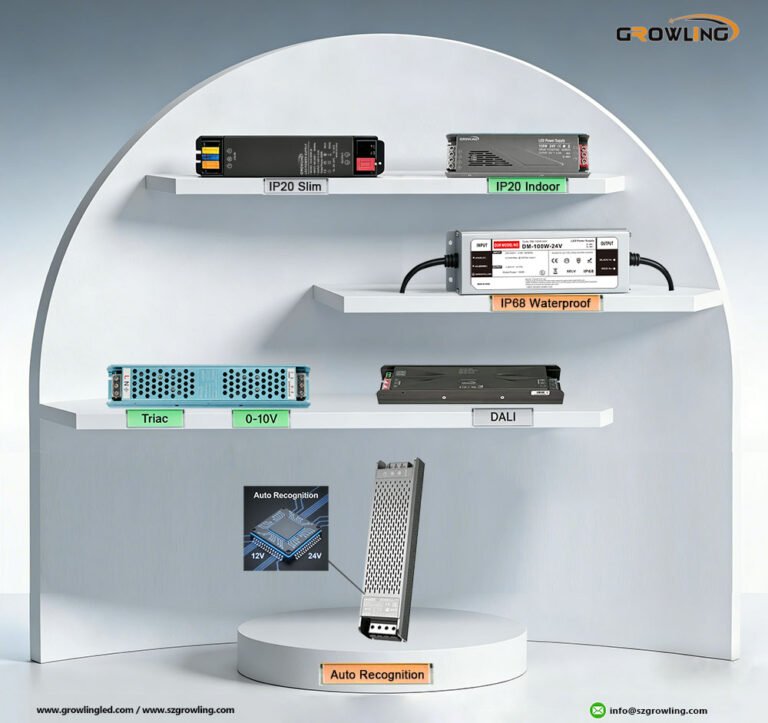
1. Waterproof Drivers: No Premium for Protection
Our extensive range of IP67/IP68 waterproof LED drivers delivers reliable protection against moisture and dust—without inflated “specialty”
pricing.
Constant voltage for landscape lighting or constant voltage for outdoor signage—our waterproof series leverages efficient, high-volume
manufacturing to keep costs competitive. Full CE/RoHS certified.
2. Indoor Drivers: Optimized for Your Exact Application
Why pay for features you don’t need? Our indoor lineup spans basic non-dimmable to advanced programmable options:
- Standard indoor series: Cost-effective for dry, stable environments
- Slim form factor series: Ultra-thin profiles for space-constrained fixtures
Match the driver precisely to your application—avoid over-engineering and overpaying.
3. Complete Dimming Coverage: DALI-2, TRIAC, 0-10V
Dimming compatibility is where many projects encounter unexpected costs—from trial-and-error testing or premium-priced “special” drivers.
Our dimmable family covers all major protocols:
| Protocol | Applications | Our Offering |
|---|---|---|
| DALI-2 | Commercial, smart offices, scene control | Fully certified, interoperable, 1-100% smooth |
| TRIAC | Residential retrofits, hospitality | Extensive dimmer compatibility |
| 0-10V | Industrial, simple commercial zones | Reliable analog control, cost-optimized |
| PWM | Architectural, flicker-sensitive | High-frequency, color-stable |
All options from a single source—simplify qualification, reduce testing overhead, consolidate purchasing volume.
4. Auto-Regnition Voltage: Inventory Simplification
Our auto-sensing (DC12V 24V Auto Recognition) LED drivers mean:
- One driver works for multiple regions and voltage systems
- You stock fewer SKUs, reducing carrying costs
- Installation errors eliminated
For distributors and OEMs serving diverse markets, this is pure efficiency—and efficiency fights margin erosion.
5. Slim Profile Drivers: Fit More, Stock Less
Space constraints create hidden costs: specialized, often expensive, ultra-compact drivers.
Our slim and linear form factor drivers deliver full power in minimal profiles—without the premium pricing typically associated with
compact designs.
How We Keep Prices Competitive
You might wonder: “If raw materials are up 35% and everyone’s raising prices, how do you remain competitive?”
- We don’t over-specify. Designs meet requirements precisely—not “just in case” over-engineering.
- We optimize supply chain. Long-term relationships and strategic purchasing mitigate spot volatility.
- Volume efficiency. Broad product range drives manufacturing scale, driving down per-unit costs.
- We pass efficiency gains to you. When process improvements occur, pricing reflects them.
Result: even in a rising market, our price-performance ratio remains among the industry’s best.
Practical Steps to Protect Your Projects
Step 1: Audit Your Requirements
List active and upcoming projects by application. Identify where you’re using multiple suppliers for similar applications.
Step 2: Identify Consolidation Opportunities
Where can one supplier cover multiple needs? If you’re buying DALI from Vendor A, TRIAC from Vendor B, and waterproof from Vendor C,
you’re missing consolidation benefits.
Step 3: Request Comprehensive Quotes
Ask potential partners for pricing across your entire requirement set—not piecemeal. The total cost picture often reveals hidden savings.
Step 4: Verify Certifications
In a rising market, some cut corners. Insist on CE, RoHS, and relevant certifications. Non-compliant products create far greater costs than
any short-term saving.
Step 5: Test Before Committing
We welcome side-by-side comparisons. Request samples, test performance, validate compatibility
Conclusion: Smart Sourcing Wins
The 2026 LED driver price adjustments are real, widespread, and driven by fundamental cost pressures across the supply chain. No single
supplier can completely escape these forces.
But how suppliers respond—and how their product range supports your optimization—makes all the difference.
By partnering with a manufacturer offering comprehensive coverage across waterproof, indoor, dimmable (DALI/TRIAC/0-10V), slim, and
auto-recognition categories, you gain:
- Consolidation leverage for better pricing
- Simplified qualification and testing
- Supply chain resilience
- Consistent quality and compliance
In short, you turn a challenging market into a strategic advantage.
Ready to see how our diverse LED driver range protects your budget?